Rice Purity Test vs Innocence Test: What’s the Difference?
Two quiz names come up again and again in group chats and college orientation weeks: the Rice Purity Test and the Innocence Test. They look nearly identical. Both are long checklists, both give you a number out of 100, and both are made for comparing with friends. So what actually separates them?
The short answer is history and tone. The Rice Purity Test is a college tradition that traces back to a 1924 student newspaper survey at Rice University. The Innocence Test is a modern internet spin-off with the same format but no campus heritage, written for a younger, social-media-era audience. The scoring, the format, and the way people use the results are broadly the same.
This guide compares both tests side by side: where each comes from, how scoring works, how the questions differ in tone, and which one fits your situation. You can take the Rice Purity Test quiz here first, then read on to see how it stacks up.
At a Glance: Rice Purity Test vs Innocence Test
| Rice Purity Test | Innocence Test | |
|---|---|---|
| Origin | 1924, The Rice Thresher student newspaper, Rice University | 2010s-2020s internet culture; no official origin or university link |
| Questions | 100 yes-or-no checklist items | 100 yes-or-no checklist items in the standard online versions |
| Scoring | Start at 100; each checked item subtracts 1 point | Same start-at-100, minus-one-point scoring on most sites |
| Tone | Classic college humor and milestones, from dating to campus rule bending | Modern, casual phrasing aimed at teens and Gen Z social dynamics |
| Main audience | University students, orientation groups, alumni | High school seniors, TikTok users, online friend groups |
| How people use it | Campus icebreaker and milestone snapshot | Shareable social content and party conversation starter |
The Historical Origins: Fact vs. Internet Lore
The Rice Purity Test: A Documented History
The Rice Purity Test has a verified origin story, which is rare for viral internet content. It traces back to the Rice Thresher, the student newspaper of Rice University in Houston, Texas. In 1924 the paper published the results of an informal ten-question survey of 119 female undergraduates, and it has revised and republished the list many times since, usually as a humor feature. Purity tests began circulating more widely online around 1980.
The version most people know today, with 100 questions worth one point each, was published online in 2012, according to the Thresher’s own reporting. That 2012 version set the modern standard: 100 checklist items, one point deducted per checked box. From there it spread through college orientation traditions, then to high schools, and finally across social media.
The Innocence Test: Known vs. Unknown
The Innocence Test, sometimes styled “The Rice Innocence Test,” is a modern spin-off of the classic checklist format. What is known: it exists online in a 100-question form that works nearly identically to the Rice Purity Test.
What is unknown is everything else about its origins. It does not trace back to a university publication or any print history. It is a product of 2010s and 2020s internet culture, most likely created by independent web developers or content creators responding to viral trends on platforms like TikTok. There is no official publisher and no historical paper trail, so any claim about who “created” the Innocence Test should be treated as unverified.
How the Scoring Works
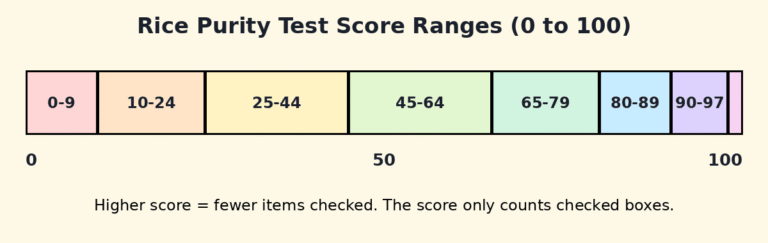
The scoring is the same on both tests. You start at 100 points, and every item you check subtracts exactly one point:
Score = 100 minus the number of items you checked
- A score of 100 means you checked nothing.
- A score of 0 means you checked all 100 items.
- Every item counts equally, so a mild item costs the same as a serious one.
A higher score means fewer items were checked; a lower score means more. That is the entire factual content of the number. Two people with the same score can have very different sets of answers, because the number never records which items were checked. To learn how to read any score, see what your Rice Purity score means or try the score meaning checker.
Tone and Question Style: Classic Milestones vs. Modern Wording
This is where the two tests actually diverge. The Rice Purity Test carries the flavor of a classic college publication: dating and romantic experiences, party and social life, and the kind of campus rule bending that defined student life for generations. The tone is nostalgic and traditional, usually taken during orientation week.
The Innocence Test is written for a younger, online audience. Its phrasing is more casual and updated to reflect modern teen life, social dynamics, and digital-era behavior. The concept is identical, but the voice is Gen Z: shorter, more conversational, aimed at people who will share the result on a story or in a group chat.
Who Takes Each Test?
The Rice Purity Test’s home turf is the university campus: college students, often during orientation week, and alumni revisiting it years later. It works as a tradition and an icebreaker for new students with different backgrounds.
The Innocence Test’s home turf is the phone screen: high school seniors, TikTok creators, and online friend groups looking for shareable content. The result is a quick social benchmark: post it, compare it, talk about it, move on. Many friend groups take both, which is why the two names keep getting mixed up.
What Your Score Actually Means (and What It Does Not)
Whichever test you take, remember what the number is and is not. A score on either test counts checked items on a self-reported checklist. It does not measure your character, maturity, morals, or worth. No researcher validated these questions, nobody verifies the answers, and the scoring treats very different experiences as identical single points.
The word “purity” invites moral reading, so this is worth stating plainly: both tests work best as entertainment. An icebreaker, a conversation starter, a fun comparison with friends. If you are wondering whether your result is typical, what counts as a good Rice Purity score explains why there is no verified average to compare against.
Which Test Should You Take?
Pick the Rice Purity Test if…
- You want the original: a documented college tradition with a century of history.
- You are comparing scores with college friends or orientation groups, where the classic version is the common reference.
- You prefer traditional, campus-style questions over modern internet phrasing.
Pick the Innocence Test if…
- You are in high school or a younger group, and the modern wording feels more relatable.
- You plan to share your result on social media and want the version your audience recognizes.
- You have already taken the Rice Purity Test and want a fresh set of questions for a second round.
Many friend groups simply take both. Identical scoring makes the two numbers directly comparable.
The Bottom Line
The Rice Purity Test and the Innocence Test are the same idea in two different outfits. The Rice Purity Test brings a documented history, from a 1924 Rice Thresher survey to the 100-question version published online in 2012. The Innocence Test is a younger internet spin-off with no university heritage but friendlier modern phrasing. The scoring is identical, the format is the same, and neither score says anything about your character. Pick the classic for tradition, the Innocence Test for a modern feel, or take both and compare.
Frequently Asked Questions
What is the main difference between the Rice Purity Test and the Innocence Test?
The main difference is history and tone. The Rice Purity Test is a documented college tradition that started at Rice University in 1924, while the Innocence Test is a modern online spin-off created for today’s social media and teen audiences. The format and scoring are nearly identical.
Are both tests scored out of 100?
Yes. Both tests start you at 100 points and subtract one point for every item you check, so a lower score means more checked experiences on either test.
Is the Innocence Test affiliated with Rice University?
No. It borrows the checklist concept and scoring system from the Rice Purity Test, but it is an unofficial internet creation with no ties to Rice University.
Does a low score on either test mean something bad?
No. A score simply counts how many items on a list you checked. It is an informal entertainment quiz, not a measure of your moral character, maturity, or worth.
Which test is better for high school students?
The Innocence Test is often preferred by younger audiences because its wording reflects modern teen life, while the Rice Purity Test includes more traditional college-style experiences. Either one works, and the scores are directly comparable.
Can I take both tests?
Yes. Many people take both and compare their scores, since the identical scoring system makes the two numbers directly comparable. Small score gaps between the two are normal, because the questions differ in tone.


One Comment