Is the Rice Purity Test Appropriate for Teens?
Published: 18 October 2026 | Updated: 18 October 2026
If you have searched “is rice purity test appropriate for teens,” you are not the only one. The quiz is everywhere in TikTok comments and group chats, teens swap scores like trading cards, and plenty of parents have seen the link and wondered what their kid is actually clicking. The short, honest answer is: it depends on the teen’s age, maturity, and the context around it. The test is a self-scored internet quiz with no official age rating, and some of its questions cover mature topics. This guide gives both sides a calm, judgment-free look at what the test contains, where it came from, and how to decide whether it fits your household.
What the Rice Purity Test Actually Is
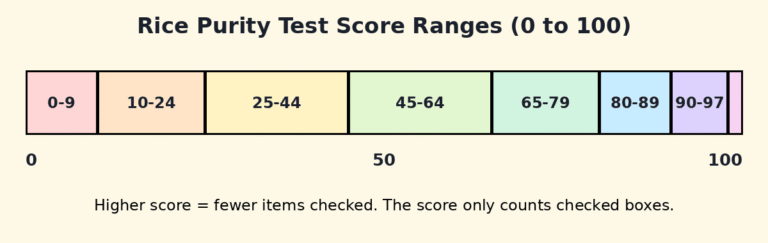
The Rice Purity Test is a 100-question yes-or-no checklist of life experiences. You check off everything you have done, and your score is 100 minus the number you checked. So 100 means the fewest checked experiences and 0 means the most. The questions run from mild things like holding hands to adult topics like alcohol, drugs, and sexual experiences.
What matters most is what the test is not. It is not scientific, not a personality test, and not anything a school or doctor would use. It is closer to a magazine personality quiz or a party icebreaker than to a real assessment. Your Rice Purity Test score measures experiences, not worth. A high score does not make anyone “good” and a low score does not make anyone “bad.” That single idea is the most important thing in this whole article.
A Short, Accurate History
The test has a real history, and it is worth getting right. It began in 1924 as an informal 10-question survey published in The Rice Thresher, the student newspaper of Rice University, given to 119 female undergraduates. The results ran under the headline “Rice Girls Not Quite Half Bad,” and the average score was 62. It was a campus joke, not a serious assessment.
The Thresher revised the test over the decades, usually on its satirical back page, and a 150-question version appeared in 1988. The modern 100-question version people share today developed much later, long after the original. If you want the full story, our Rice Purity Test history page covers it in detail. The takeaway for this question: it was created by college students, for college students, as entertainment.
What the Questions Cover, and Why That Matters for Teens
Parents usually want to know one thing: what is actually in the questions? They start mild and get progressively more adult. The early stretch covers dating and social life. The middle covers parties, alcohol, and rule-breaking. The back half covers sexual activity in plain but not graphic language, plus drugs, run-ins with the law, and other risky behavior. Nothing is described in explicit detail, but the topics in the later questions are unmistakably adult.
That is the core of the debate. A younger teen working through all 100 questions will meet topics they may not have encountered yet. Some see that as harmless curiosity. Others see it as too much, too soon.
There is also a quirk worth knowing: the scoring treats every checkbox equally. Holding hands costs one point, and so does something far more serious. The number cannot tell the difference, which is one more reason it should never be read as a verdict on anyone.
Age Guidance: A Practical Framework
There is no official age rating, so think in brackets rather than a hard rule.
Ages 13 to 15: generally better to skip. Many questions cover mature themes that are simply not relevant yet for younger teens, and the “purity” framing can feel like a real judgment at this age. If curiosity wins, going through it with a parent is far better than taking it alone in a group chat.
Ages 16 to 18: it depends on the teen. Older teens encounter the test constantly on social media and usually understand it is a joke quiz. The main risks here are peer pressure and score comparison, not the content itself. A teen who is comfortable with the topics and treats it as entertainment is in a very different position from one who feels pressured to take it.
18 and up: the target audience. The test was made by college students for college students, and this is where it fits most naturally.
Three questions help any family decide: Is the teen comfortable with the content, or would it cause distress? Are they taking it out of curiosity, or because everyone in the group chat is doing it? And do they understand that a posted score is permanent and can be misread by strangers, coaches, or future schools?
Tips for Teens
If you decide to take it, a few ground rules keep it fun:
- Take it for yourself, not for a score to show off. The number is not a trophy.
- Never post your score publicly. Screenshots travel further than you think.
- Do not let anyone pressure you into answering in front of a group. Your answers are your business.
- Skip anything that makes you uncomfortable. There is no prize for finishing all 100.
- Remember the golden rule: the test counts experiences, not worth.
Tips for Parents
A flat ban usually backfires. Teens can find the test in seconds on any phone, so banning it mostly means they take it without you knowing. Curiosity is normal, and staying calm helps more than interrogating.
Try an open question instead of an accusation: “Have you seen this quiz going around?” Review the test yourself first so you know what is in it. Explain that it is just for fun, agree that scores stay private, and make clear that no score is good or bad. Many parents use the moment as a low-key opening for bigger conversations about boundaries, peer pressure, and online sharing. That conversation is worth more than any rule about the quiz itself.
The Bottom Line
So, is the Rice Purity Test appropriate for teens? For older teens who take it privately or with trusted friends, understand it is just a game, and keep their scores to themselves, it is generally fine. For younger teens, waiting or going through it with a parent is the wiser call. The test itself is neither dangerous nor meaningful. What matters is the context around it: no pressure, no public scores, and the clear understanding that a number from a 1920s campus survey says nothing about who you are. You can take the free Rice Purity Test whenever you are ready, on your own terms.
Frequently Asked Questions
What age is the Rice Purity Test meant for?
It was created by and for college students, so it fits ages 18 and up most naturally. Older teens of 16 and above often take it too, but it is generally not the best fit for younger teens.
Is the Rice Purity Test safe for 13 or 14 year olds?
It is probably too mature for most 13 and 14 year olds. The later questions cover sexual activity, drugs, and risky behavior. Parents may prefer younger teens wait, or go through it together with them.
Should parents be worried if their teen takes the Rice Purity Test?
Usually not. Taking the quiz is a common social trend, not a warning sign. Staying calm and open to conversation is more helpful than worrying or banning it outright.
Does a low Rice Purity Test score mean something is wrong?
No. A low score only means more boxes were checked on a list. It says nothing about character, morals, intelligence, or the future.
Do I have to share my score with friends?
No. Your answers and your score are your own business. “I do not want to share my score” is a complete sentence, and nobody should pressure you.
Where did the Rice Purity Test come from?
It started as a 10-question survey in the Rice University student newspaper in 1924. The 100-question version shared online today developed much later.
Is the Rice Purity Test scientifically valid?
No. It is a self-scored entertainment quiz, not a psychological test or diagnostic tool. Treat it like a magazine quiz, not a real assessment.
Disclaimer: This article is for information only. The Rice Purity Test is a self-graded social quiz, not a scientific or medical assessment.

One Comment