Rice Purity Test Questions: The Full 100 Questions List
The questions themselves are the heart of the Rice Purity Test. Your score is just a number, but the 100 items behind it are what make the quiz fun, relatable, and a little nerve-wracking to compare with friends. This guide explains the full list of questions: where it came from, how the items are organized, what topics they cover, and where to read and answer all 100 of them yourself.
Before anything else, a quick grounding: the score counts how many items you checked. Score equals 100 minus the number of checked items. It is a self-reported checklist, not a scientific measure, and it says nothing about your character or morals. With that settled, here is the full picture of the questions behind the number.
A Brief History of the Test
The test traces back to the Rice University student newspaper, the Rice Thresher. According to Wikipedia’s entry on purity tests, the Thresher published the results of an informal ten-question survey of 119 female undergraduates in 1924. The paper revised the list many times over the decades, usually as a humor feature, and purity tests began circulating online around 1980.
The Thresher’s own reporting says the version most people know today, with 100 questions worth one point each, was published online in 2012. That is the list covered in this article: the standardized 100-item checklist that became a college orientation tradition and a social media staple.
How the 100 Questions Are Structured
Every one of the 100 questions is a yes-or-no item, and every item carries the same weight: one point. Check 0 items and your score is 100. Check all 100 and your score is 0. The scoring math is explained step by step in our guide to how the Rice Purity Test works.
The order of the questions is part of the design. They are arranged roughly from common, everyday experiences toward rarer or riskier ones, so most people check early items first and the list gets progressively harder to relate to. That is why a high score usually means you stopped checking early in the list, while a lower score means you checked items across more of it.
A few structural facts worth knowing:
- Equal weight. Holding hands costs exactly one point, and so does anything near the end of the list. The test treats every experience as identical.
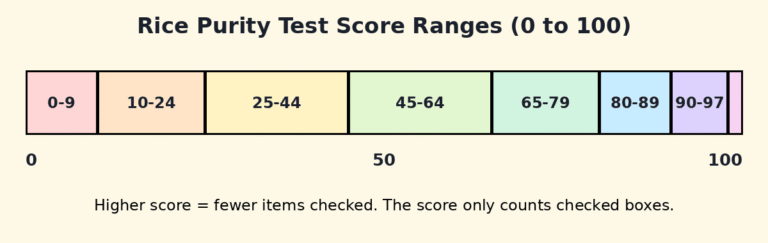
- No official scoring bands. The test has no scientific scoring key. Any “what your score means” chart is an unofficial interpretation. Ours is here: Rice Purity Test score meaning.
- Wording varies slightly between versions. The test has no official owner, so different sites reword, reorder, or swap a few items. The 100-question structure is consistent, but exact phrasing is not.
What the 100 Questions Cover
Rather than listing the questions one by one, here is how the classic list is grouped by topic, in the order the themes roughly appear. This summary describes the structure of the standard list; wording on individual sites may differ slightly.
The first block, roughly the first 40 items, centers on dating and relationships: first dates, holding hands, kissing, physical affection, breakups, and dating-app experiences. These are the items most people check first, and they are the reason high scores are common among younger test takers.
The next stretch covers rule-breaking: lying to parents, sneaking out, skipping school, cheating on tests or homework, shoplifting, vandalism, and run-ins with authority, up to arrests and probation. These items are often reported informally as the ones that make group score comparisons dramatic.
The middle of the list turns to alcohol and driving: trying alcohol, being drunk, blacking out, hangovers, underage drinking, fake IDs, and then driving experiences such as speeding tickets, texting while driving, and accidents.
After that come substances and parties: tobacco, vaping, marijuana, other recreational drugs, and party-related items. A smaller block covers betting and games involving money.
The final stretch covers life milestones rather than rule-breaking: tattoos, piercings, dyed hair, travel, living on your own, jobs, volunteering, donating blood, broken bones, hospital stays, and performing on stage. These read less like dares and more like a coming-of-age checklist, which is why people far past college age often find the last items relatable.
Because the wording differs a little between versions, treat any single published list as one faithful version of the test, not the one true copy.
The Full 100 Questions List: Where to Read Them
The complete list of all 100 questions is on our interactive quiz page. Open the Rice Purity Test quiz to read through every item, check the ones that apply, and get your score at the end.
Reading the list on the quiz page has a practical advantage over a static copy: you see the questions exactly as they are scored on the version you are taking. Since sites vary the wording slightly, taking the same list you read is the cleanest way to get a consistent score, and it makes comparing scores with friends straightforward when everyone uses the same page.
If you prefer to skim the themes before committing, the category walk-through above covers the arc of the list from dating through rule-breaking to life milestones.
How to Answer the Questions Honestly
The test only works as intended when you answer honestly, but it is entirely voluntary. Nobody checks your answers, and there are no consequences for any response. A few tips:
- Go with your first instinct. Most items are clear enough that you know your answer immediately. Overthinking edge cases is what moves scores by a few points between sittings.
- Interpret borderline items your own way. A few questions are ambiguous, and two honest people can read the same item differently. Pick the reading that feels truest.
- Skip anything you are uncomfortable with. You can stop the test entirely at any point. It is a novelty checklist, not an obligation.
- Take it once and compare fairly. If you and your friends want to compare scores, use the same site on the same day, and make sure every box starts empty.
Using the List with Friends
The questions work best as a group icebreaker: everyone takes the quiz separately, then shares scores and laughs about the specific items that moved the number. Keep three things in mind:
- Voluntary only. Never pressure anyone to take the test or share a score. The fun disappears the moment it stops being a choice.
- No judging answers. The number is a count of checked boxes, not a character grade. A low score does not mean someone is reckless, and a high score does not mean someone is sheltered.
- Keep it casual. The test is entertainment and a conversation starter. It was born as a student newspaper joke, and that is still the right frame for it.
The Bottom Line
The 100 questions run from first dates to life milestones, each worth exactly one point, and the full list is ready to read on the quiz page. Once you know your score, you can read what the ranges generally indicate in our score meaning guide, and if you are curious about the list’s origins, the history of the Rice Purity Test covers how a 1924 campus survey became a 100-question internet tradition.
Frequently Asked Questions
How are the 100 questions ordered?
The questions generally follow a progression from common, early-life experiences toward rarer or more mature ones. They begin with dating and affection milestones, move through rule-breaking and party experiences, and end with general life milestones. Most people check early items first.
Do different websites have different questions?
Mostly the same list with small tweaks. The test has no official owner, so sites sometimes reword, reorder, or swap a few items while keeping the 100-question structure. For a fair comparison with friends, everyone should use the same site.
Do I have to answer every question honestly?
The test is entirely self-reported and meant for entertainment, so it only reflects your experience if you answer honestly. But there are no real-world consequences, and no one checks your answers. If an item makes you uncomfortable, skip it or stop.
Can I skip questions if I feel uncomfortable?
Yes. The quiz is informal and voluntary. You can leave any item unchecked or stop taking the test at any point, and your experience stays yours alone.
Does a low score mean someone has bad character or morals?
Not at all. The score counts how many checklist items you checked. It says nothing about personal integrity, kindness, intelligence, or moral character. Nobody’s worth is contained in a number between 0 and 100.
Why do college students love taking the test?
It has become a classic collegiate icebreaker. Comparing scores during orientation week or dorm hangouts is a lighthearted way to share stories and bond over shared experiences, which is how a 1924 campus survey turned into a global tradition.
4 Comments