Rice Purity Test for 14 Year Olds: Guide for Teens
Published: 18 November 2026
Updated: 18 November 2026
If you have spent time on social media or talked with friends at school, you have probably heard people mention the Rice Purity Test. It often comes up in group chats, short videos, and lunchtime conversations as a quick online quiz that gives you a number between 0 and 100. If you are looking into the rice purity test for 14 year olds, here is the honest answer right away: the standard test is not designed for 14-year-olds, and there is no need to take it or compare scores with anyone.
Because the quiz was originally created around college life, many of its statements cover adult experiences that have nothing to do with middle school or early high school. Understanding what the test actually is, where it came from, and how to handle peer curiosity can help both teens and parents approach the topic with clear expectations.
What Is the Rice Purity Test?
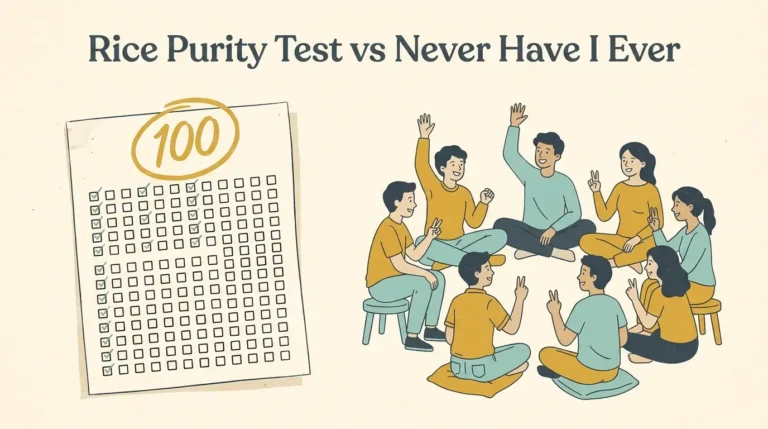
The Rice Purity Test is an informal, self-graded checklist found on various websites across the internet. Many versions contain 100 statements about life experiences, and a person checks off each statement that applies to them.
The scoring system generally starts at 100. Each checked statement reduces the score by one point. For example, if someone checks 20 statements on a 100-question version, their score would be 80. This is simply how the quiz calculates its result. It does not measure a person’s intelligence, personality, maturity, or development.
It is important to remember that this is simply an internet trivia checklist. It is not a psychological test, a school assessment, or a scientific measure of behavior. It was not written by experts to evaluate teens, and it has no established ability to measure personal growth. Online versions may also differ in their wording, available questions, and privacy practices, so results from one website may not match another.
A Brief History of the Rice Purity Test
The Rice Purity Test is associated with Rice University in Houston, Texas. Its documented history includes a 10-question survey published in The Rice Thresher in 1924, answered by 119 female undergraduate students. Longer versions appeared in later years, including a 150-question version printed in the newspaper’s 1988 April Fools’ edition. The familiar 100-question format developed later, but its exact origin date is not clearly established by available historical records.
Over time, the checklist moved off campus and onto early internet forums and social media platforms, where it gradually became popular among college students and teenagers. Many of the websites that host the test today have no connection to Rice University. It was not developed as a test for younger teenagers or as a tool for measuring personal development.
Is the Rice Purity Test Suitable for 14-Year-Olds?
When considering the rice purity test for 14 year olds, the straightforward answer is that it is not designed for this age group. The questions were written with college students in mind, and many topics are aimed at older teens and adults.
Many items on the checklist reference adult relationships, substance use, legal trouble, and serious rule-breaking. For a 14-year-old who is still in middle school or just starting high school, these topics can feel confusing, uncomfortable, or simply out of place.
The content also varies between websites. A teen may encounter a version with questions they were not expecting, so parents should review the content first before deciding whether their teen should see it at all.
There is no need for a 14-year-old to take the Rice Purity Test. Hearing about it from friends or seeing it online does not mean they need to participate. They can simply choose not to open it or stop reading if something makes them uncomfortable. Being curious about an online quiz is normal, but curiosity does not mean someone needs to answer personal questions or share private experiences.
Why a Rice Purity Score Does Not Define You
Online trends sometimes make a simple number feel bigger than it really is. Whether someone ends up with a high score or a low score, that number does not say anything meaningful about who they are as a person.
A Rice Purity score is just a number produced by an informal checklist. It does not measure character, kindness, maturity, intelligence, or personal worth. It cannot tell you whether someone is a good friend, a responsible person, or someone who deserves respect.
People grow up in different environments and have different experiences. Their choices are influenced by their families, cultures, interests, personal boundaries, and circumstances. A quiz cannot capture all these differences.
At 14, you are still learning, growing, and figuring out your own values. A checklist of life experiences is far too simple to describe a real person, and it should never be used to judge yourself or anyone else. You do not need a number from an online quiz to understand yourself. Your interests, values, goals, and relationships are much more meaningful parts of who you are.
Peer Pressure and Comparing Scores
At 14, it is very common to want to fit in with your friend group. Sometimes friends will bring up viral quizzes, compare numbers, or joke about scores, even if they do not fully understand what the questions mean. These conversations can create pressure to participate, even when you do not feel comfortable.
If you feel pressured to take the quiz or share a score you do not want to talk about, remember that saying no is completely okay. You do not have to explain your decision or share personal information to fit in with a group. You can change the subject, leave a conversation, or tell a friend that you are not interested in discussing the test.
Keeping your personal experiences private is also a healthy habit to build early. You never owe anyone a list of personal details about your life, and sharing them online can lead to embarrassment or unwanted attention later. Friendships should not depend on answering personal questions or participating in online quizzes. Respecting someone’s boundaries is an important part of being a good friend.
Privacy and Online Quiz Safety
Whenever you visit a quiz website on your phone or computer, basic internet safety should always come first. Many free quiz sites are created to collect clicks and show ads, and some may not protect your privacy the way they should.
Before using any online quiz website, consider what information it asks you to provide. A simple quiz should not require unnecessary personal details. Avoid sharing your:
- Full name
- Email address
- School information
- Phone number
- Social media accounts
Be careful with screenshots of quiz results. Even if a screenshot seems harmless, it may reveal personal information or become part of a conversation you did not intend to share publicly.
It is also important to watch for suspicious advertisements, popups, and unrelated links. Not every quiz website has the same privacy practices, and some may collect information about visitors. If a website asks for information that makes you uncomfortable, leave it. You can also ask a parent or trusted adult to help you understand whether a website is safe.
A Parent’s Guide to Talking About the Test
If you are a parent and your 14-year-old mentions the Rice Purity Test, the best first step is to stay calm. The topic usually comes up because a friend or a video mentioned it, not because your teen is in any kind of trouble.
Approach the conversation with curiosity rather than judgment or shaming. Start by asking what they heard about the quiz and why they are interested in it. You might ask, “Where did you hear about it?” or “What do you think it is?” Listening first helps your teen feel safe enough to ask honest questions.
Explain that some online quizzes are designed for older audiences and may contain topics that are not appropriate for younger teens. You can also discuss privacy, boundaries, and the importance of making personal decisions without pressure.
Avoid shaming your teen or making them feel that asking questions is wrong. A supportive conversation can make it easier for them to approach you when they encounter confusing or uncomfortable content online. Parents can also remind teens that they are not required to share personal experiences with friends or participate in every online trend.
What Teens Can Do Instead
If you enjoy taking online quizzes with friends, there are plenty of fun, age-appropriate alternatives. You can try personality quizzes, trivia challenges, music or movie quizzes, and creative prompts that are designed for teens and do not involve adult topics.
Beyond screens, focusing on hobbies, sports, creative projects, or learning a new skill gives you real confidence and something interesting to talk about with friends. Joining a club, starting a small project, or setting a personal goal can be far more rewarding than comparing numbers on a quiz.
Growing up is not a race. Everyone moves at their own pace, and there is no deadline for learning new things or having new experiences.
Final Thoughts
The rice purity test for 14 year olds is a topic that deserves careful and honest guidance. The standard test is not designed for younger teens, and some of its questions may be inappropriate or uncomfortable for this age group.
There is no need to take the test to fit in with friends or understand yourself better. A score cannot measure your character, kindness, maturity, or worth.
If you encounter the Rice Purity Test online, you can choose not to participate. If you have questions about it, talking with a trusted adult can help you understand the topic without pressure or judgment. Your personal experiences are your own, and you do not need an online quiz to define who you are.
FAQs
What is the Rice Purity Test?
The Rice Purity Test is an informal, self-graded checklist about personal experiences. Many online versions contain 100 statements and calculate a score based on the answers. It is an informal quiz, not a scientific test.
Is the Rice Purity Test made for 14-year-olds?
No. The test is associated with college students and is not specifically designed for younger teens. Some versions contain topics that may be inappropriate for this age group.
Can a 14-year-old take the Rice Purity Test?
A 14-year-old may encounter it online, but the standard test is generally not recommended for younger teens. There is no need to take it, and parents should review the content before deciding whether it is appropriate.
Does a high Rice Purity score mean someone is better?
No. A score does not measure someone’s character, kindness, maturity, intelligence, or worth. It is simply a number calculated from an informal checklist.
Should teens compare their Rice Purity scores with friends?
It is better not to compare scores. Doing so can create unnecessary pressure to share private experiences or feel different from others. Everyone has their own boundaries and experiences.
What should parents do if their 14-year-old asks about the Rice Purity Test?
Parents can explain what the test is, discuss why some questions may be intended for older audiences, and encourage safe online choices. A calm, open conversation is more helpful than shaming or punishing curiosity.
Is the Rice Purity Test scientifically accurate?
No. It is an informal questionnaire, not a scientifically validated assessment. It cannot accurately measure personality, maturity, morality, or personal development.