What Does a High Rice Purity Score Mean?
Published: October 30, 2026
Updated: October 30, 2026
You finished the Rice Purity Test, and the number on the screen is high. Maybe it is 88. Maybe it is 95. Maybe it is a perfect 100. Now comes the question everyone asks next: what does that actually say about me?
The honest answer is simpler than the internet makes it sound. A high score means you checked very few boxes on a 100-item list. That is all the number measures. It is not a grade, not a personality result, and not a verdict on who you are.
How the scoring works
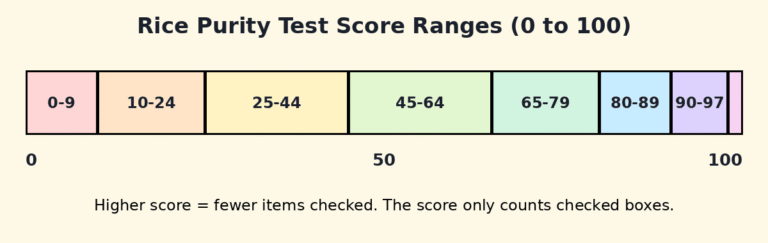
The Rice Purity Test lists 100 statements about life experiences. You tick every statement that applies to you, and your score is 100 minus the number of ticks. Check 12 boxes and you score 88. Check 5 and you score 95. Check none at all and you score 100.
Every item counts the same: one point, no more and no less. The test does not rank items by seriousness, does not ask when something happened, and does not ask how often. A small, everyday item costs exactly as much as a big, life-changing one. A high score is not a pass mark. It is a short count.
What counts as “high”?
Here is something many result pages skip: nobody official has ever defined a high score. Rice University does not publish a cutoff, and the people who made the original test never set one. So when a site or a friend calls a score “high”, that is informal language, not an official label.
In practice, online quiz communities tend to use rough bands. Scores above 80 are often described as high, scores in the 90s are often called very high, and a score of 98 to 100 is usually talked about as almost nothing checked. Treat those bands as casual shorthand, not as a scientific scale. Different sites draw the line in different places, and no band has any authority behind it.
The same caution applies to averages. Quiz sites often report informal averages, commonly somewhere in the 60s, but those figures come from website visitors, not from a controlled study. A high score sits above the middle of the informal range, and the exact boundary is blurry because the test was never designed to have one.
What a high score does mean
A high score means one thing for certain: fewer of the listed experiences have happened to you so far. The list covers a wide mix of everyday life, social life, rule-breaking, and more grown-up experiences. A high score says the checklist matched only a small part of your life up to now.
There are plenty of ordinary reasons for that. You may be younger than the average test taker, live where certain experiences are less common, or have different interests, friend groups, or timetable. Some people actively choose to skip certain things, while others just have not come across them yet. The score cannot tell those stories apart. It is a snapshot at one point in time, not a biography.
What a high score does not mean
This is where most misunderstandings start, so it is worth being direct.
A high score does not mean you are a better person. It does not mean you are more moral, more trustworthy, or more worthy of respect than someone with a lower score. The test does not measure kindness, honesty, courage, or character. It counts experiences, and experience counts are not character counts.
A high score also does not mean you are naive, sheltered, or boring, even though those labels get thrown around online. The number cannot explain why a box stayed unticked. It does not know whether something was avoided on purpose, missed by chance, or simply not relevant to your life yet. Judging a person from a checklist is like judging a book from its page count.
And a high score does not predict your future. It is not a promise that you will stay high, and it is not a warning about who you will become. It describes the past, up to today, and nothing more.
Why scores usually fall over time
If you retake the test honestly in a year or two, your score will most likely stay the same or go down, not up. That is built into the design. Each new experience that matches an item takes one more point away, and nothing on the list ever adds points back.
That is why a high score is often temporary, especially in the teen and college years, when new experiences pile up quickly. A score that looks high at 17 can look quite different at 21, and that change says nothing bad about you. It just means life happened.
The same one-way movement is why comparing scores across ages is misleading. A 19-year-old with a 92 and a 25-year-old with a 70 have lived different lengths of life in different settings, and the checklist treats all of that as one flat count.
A high score compared with a low score
A low score means many boxes were checked. A high score means few were checked. The gap between them is arithmetic, not a ranking of people.
Because every item is worth one point, two people can hold the same score for completely different reasons. One person may have ticked a long list of mild, everyday items, while another ticked a shorter list of bigger items plus a few small ones. The final number hides all of that detail, which is why it works as a conversation starter but fails as a character reference.
What about a perfect 100?
A score of 100 means not one item on the list applied to you. It is rarer among older test takers and more common among younger ones, who have had less time to collect experiences. A 100 is not a trophy and it is not a problem. It is the top of a checklist, and like every other score, it will probably change as life goes on. Feeling proud, embarrassed, or nothing at all about it is normal, and none of those reactions changes what the number is: a count of zero ticks.
How to treat your high score
Enjoy it if you want to. Share it with friends, laugh about it, compare notes. The Rice Purity Test began as a bonding exercise among students, and it still works best that way, as something to talk about rather than something to be judged by.
Do not hand the number more power than it has. Do not let it decide how you see yourself, and do not let anyone else use it to decide that for you. A high score says you have checked fewer boxes so far. It does not say what you value, how you treat people, or what kind of person you are. The rest of you is not on the checklist.
Related guides: take the test on the homepage, read what scores mean in full, see what a low score means, trace the test history back to a 1924 Rice Thresher survey, read the full 100 questions, and learn how retakes work.
FAQs
Is a high Rice Purity score good?
Not in a moral sense. A high score means you checked fewer items. The test counts experiences, so it cannot grade them as good or bad.
What number is considered a high Rice Purity score?
There is no official cutoff. In informal online discussions, scores above 80 are often called high, and scores in the 90s are often described as very high. These labels come from quiz communities, not from an official scale.
Does a high score mean I am sheltered or naive?
No. The score cannot tell you why boxes were left unticked. Age, environment, timing, personal choice, and plain chance all play a part, and the number does not separate them.
Can a high score go down?
Yes. On an honest retake, scores usually stay the same or fall over time, because each new experience that matches an item subtracts one point. Nothing on the list adds points back.
Is there an official average Rice Purity score?
No official average is published by Rice University or the original test creators. Quiz sites often report informal averages, but those are community numbers from website visitors, not official statistics.
Does a high score mean I am more moral than someone with a low score?
No. The test does not measure morality, kindness, or character. It only counts how many listed experiences you have had.
Why do people care about this score if it does not mean much?
Because it is a social icebreaker. It started as a student bonding exercise and became a viral quiz. People compare numbers because it is fun and a little awkward, not because the number defines anyone.