Rice Purity Test Rules: Honest Answers, Retakes, and Sharing
Rice Purity Test Rules: Honest Answers, Retakes, and Sharing
Before you take the Rice Purity Test, it helps to know what the rice purity test rules actually are. The short answer: there is no official rulebook. The quiz is a self-graded checklist, not a standardized exam, so nobody can enforce how you answer, how often you retake it, or whether you share your score. Still, a few widely followed guidelines make the experience better for everyone: answer based on your own experiences, take it yourself, and share only what you feel comfortable sharing.
Are There Official Rice Purity Test Rules?
When people say “official rules,” they are using informal shorthand. There is no governing body, no answer key to submit, and no authority checking your responses. Different websites run slightly different versions of the quiz, with their own wording and interfaces, so the exact experience can vary from site to site.
That does not mean anything goes. The rules below are the sensible conventions most people follow. Think of them less like laws and more like the instructions on a board game: nobody is watching, but the result means more when everyone plays the same way.
Rule 1: Answer Based on Your Own Experiences
The one rule that matters most is honesty. Answer each item according to what has actually happened in your life, not according to what your friends expect or what sounds more interesting.
Rule 2: Take the Test Yourself
Your result should be built from your own experiences, not someone else’s. This comes up most often when groups take the quiz together:
- Answer your own questions. Friends can sit together while taking it, but no one should be picking answers for someone else.
- You do not have to justify your answers. Nobody needs to see your screen to believe your score.
- Take your time. Racing through the list increases the chance of checking something by mistake.
How Skipping Questions Affects Your Score
Not every item will apply to everyone, and you might feel uncomfortable with a question here and there. On the typical checkbox version of the test, leaving an item unchecked simply means it subtracts nothing from your score. Your total will be higher than it would be if you had checked it, because checked items are the only ones that lower the number.
One practical note: some quiz websites require every question to be answered before they show a final score. If the site you are using blocks the result until everything is filled in, check that site’s instructions rather than assuming every version works the same way.
For more on the math behind the number, see how the Rice Purity Test scoring works.
Can You Retake the Rice Purity Test?
Yes. There is no official waiting period and no limit on how many times you can take it. Most people retake the quiz months or years later, out of curiosity about how their result has changed.
Your score does not have to stay the same between sittings. New experiences, a different reading of a borderline item, or simply a clearer memory can shift the total by a few points. A different website’s version of the quiz can produce a different number too, since sites reword, reorder, or even cut items.
Retaking is entirely optional. It is not a requirement, and it is not a challenge to check more items. You can retake the quiz anytime and compare with your earlier result, or never touch it again. We cover this in more depth in can you retake the Rice Purity Test.
Taking the Test With Friends or a Partner
The test is often a social activity, especially during college orientation season. Groups can each complete the quiz on their own and compare scores afterward if everyone wants to join in. Nothing about taking it together creates an obligation to share private details. Groups tend to work best with a few house rules:
- Everyone answers their own items, on their own screen.
- Sharing scores is optional. A “pass” should be accepted without questions.
- Nobody has to explain an answer or prove an experience.
- Anyone can stop or leave the conversation at any point.
- No teasing, ranking, or pressuring based on results.
These are social conventions, not official requirements. They are worth stating out loud because they turn a fun comparison into a comfortable one.
What Happens If You Lie on the Test?
There is no formal penalty for inaccurate answers. The quiz is self-graded, so no system flags a false response, suspends an account, or marks your score invalid.
The only real consequence is that the result stops reflecting your actual experiences. A score built on answers that are not yours is just a number on a screen. Since the result is only meaningful as a personal record or a conversation starter, honesty is what gives it any value.
Sharing Your Score: Privacy and Etiquette
Whether to share your result is completely your decision. Plenty of people keep their scores private, and that is the normal choice, not an exception. If you do decide to share, a few precautions keep things comfortable:
- Share only what you are comfortable with. You can share the number without sharing which items you checked.
- Be careful with screenshots. A screenshot of a completed checklist reveals your answers, not just your score. Crop or skip it if you would not say those things out loud.
- Check the site’s privacy practices. Do not assume a quiz keeps nothing about your visit just because it is free. Our own guide to Rice Purity Test privacy explains what anonymity usually means on these sites.
When someone else shares their score with you, respond the way you would want people to respond to yours. Do not assume what their number says about them, and never use a result to pressure someone into discussing experiences they have not volunteered.
A Quick Note on Where the Test Comes From
The rules make more sense once you know the test was never designed as a serious instrument. The earliest documented version was a ten-question survey of 119 female undergraduates published in the Rice Thresher, Rice University’s student newspaper, in 1924. The newspaper revisited the list many times over the decades, usually as a humor feature, and accounts describe an expanded version in 1988, with the familiar 100-question online format associated with a later 2012 revision. Independent websites have copied and adapted the quiz ever since, which is exactly why no single official rulebook exists. The full story is in our history of the Rice Purity Test.
The Bottom Line on Rice Purity Test Rules
The rice purity test rules boil down to this: answer for yourself, follow the instructions of the version you are using, and treat retakes and score sharing as optional. The quiz is a casual checklist and a conversation starter, not a standard anyone has to meet. If you want help reading your result, the score meaning guide walks through what each range of the number describes.
Frequently Asked Questions
Do you have to answer every Rice Purity Test question honestly?
No one can enforce your answers, but answering honestly gives you a result that better reflects your experiences. You can stop or leave a question unanswered if you feel uncomfortable, although the site you use may need complete answers to calculate a final score.
Can you retake the Rice Purity Test?
Yes, you can generally retake it whenever you want. There is no universal waiting period or official limit, although your score may differ if your experiences or the question list have changed.
Can you take the Rice Purity Test with a partner?
Yes. Partners can complete the quiz separately and compare scores if both want to participate. Neither person has to reveal individual answers or explain personal experiences.
Does skipping questions change your Rice Purity Test score?
An unchecked question usually does not subtract a point in the common scoring format. However, some quiz websites require every question to be answered before they display a completed score.
Is there a penalty for lying on the Rice Purity Test?
No formal penalty exists for giving inaccurate answers on this informal self-graded quiz. Your score will simply be less representative of your actual experiences, and you do not have to prove your answers to anyone.
Do you have to share your Rice Purity Test score with friends?
No, sharing is entirely optional. You can keep your result private, and friends should respect that decision without pressuring you to join the comparison.
What does a high or low Rice Purity Test score mean?
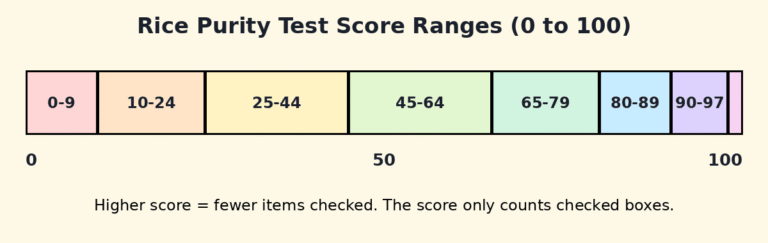
A higher score means fewer experiences were checked on that particular list, while a lower score means more were checked. Neither score measures someone’s character, morals, maturity, or worth.