Rice University Purity Test: The Original Campus Version
Published: 24 November 2026
Updated: 24 November 2026
If you have ever taken the viral 100-question checklist online, you might wonder why it is named after a private research university in Houston, Texas. Before it became a staple of group chats and social media feeds, the rice university purity test started as a lighthearted campus tradition at Rice University.
Over the course of a century, it grew from a short student newspaper survey into a dorm-room icebreaker, and eventually into the digital quiz millions of students take today. If you want to see where your own score lands right now, you can try the classic format on our homepage quiz before diving into how the original campus version came to be.
Where Did the Rice University Purity Test Come From?
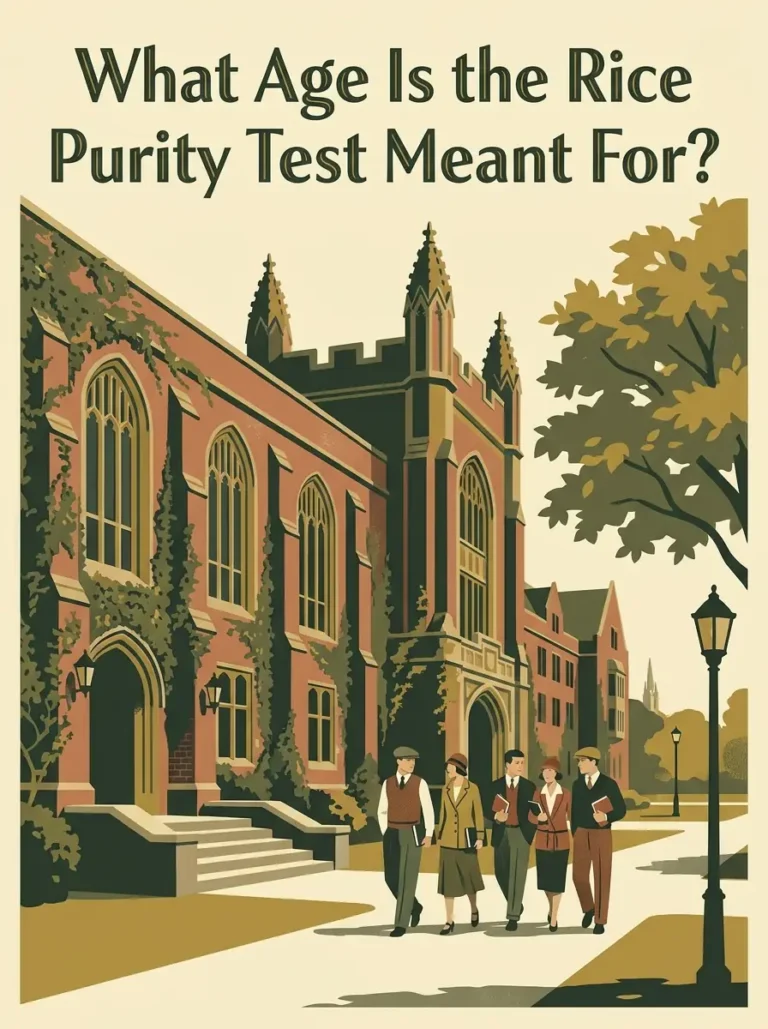
The story begins in March 1924 at the Rice Institute, which later became Rice University. At the time, the school had been open for just over a decade, and campus life came with strict curfews, dress codes, and social rules.
In the March 7, 1924 issue of The Rice Thresher, the university’s student newspaper, student editors published the results of an informal survey completed by 119 female undergraduates. Unlike the long checklist people recognize today, that original survey had only 10 questions.
The questions reflected the culture of the 1920s and poked gentle fun at campus expectations, asking about everyday experiences and behavior that students might have considered personal or socially sensitive at the time. The newspaper report is an important historical record because it shows that the idea of asking college students about their experiences was already present at Rice many decades before the modern online quiz.
From the very beginning, the survey was a student-written piece rather than an official school test. Rice University administrators did not create it, grade it, or use it to evaluate students. It was simply a humorous snapshot of college life written by students for their peers.
It is important to understand what this early document actually was. The 1924 survey was not a printed version of the current 100-question Rice Purity Test. It was a short campus questionnaire reported in a student newspaper, and the familiar online checklist came through later stages of the tradition. Many websites describe the test as if the same 100 questions had been used since 1924, but the historical record does not support that claim. The original survey and the modern checklist are connected, but they are not identical.
How the Test Became a Campus Tradition
College campuses have long used informal questionnaires, social activities, and student-created traditions to help people get to know one another. The Rice purity survey fits into that wider history of campus culture.
At Rice, the student newspaper became an important part of the test’s story. The publication revisited the subject in later years, and the questionnaire developed through student use and newspaper editions. The test was associated with conversations among students rather than with a formal academic examination.
Over the following decades, upperclassmen and student writers periodically revived and tweaked the list, passing printed or photocopied copies around campus. The quiz became closely tied to Rice’s residential college system and Orientation Week, known on campus as O-Week. During the first week of the fall semester, incoming freshmen would gather in dorm common rooms, fill out paper copies of the test with pencils, and compare scores to get to know one another.
A purity test can be understood as a social checklist. People answer questions about experiences, then compare or discuss their responses if they choose. The appeal is not necessarily the score itself. It is often the conversation that follows.
The test also reflects the attitudes of the time in which each version was written. Questions that appeared in an older campus edition may sound different from questions found in a modern online version. Social expectations, language, and student life change, so the checklist has changed as well.
From 10 Questions to the 100-Question Online Format
The Rice Purity Test did not remain a ten-question survey. One of the most important later records appeared in the April Fools’ edition of The Rice Thresher in 1988.
That edition used the joke name The Rice Trasher and published a purity test containing 150 questions. It shows how far the questionnaire had expanded from the short survey reported in 1924. The 1988 edition is also a useful reminder that the test was part of student newspaper culture. It appeared in a humorous newspaper setting, not as a formal university assessment, and its purpose and presentation were tied to campus life.
By the late 1980s, students had streamlined the growing list into a clean 100-question format. Having exactly 100 items made the math effortless: everyone started at 100 and subtracted one point for every box they checked. A 100-question Rice Purity Test is documented in a later Thresher issue from November 1998, which gives readers a dated record of the shorter format that became familiar in later online versions.
The timeline therefore includes different question counts. The early survey had ten questions, the 1988 newspaper version had 150, and a 100-question edition took shape in the late 1980s and is documented in the 1990s. These are separate stages in the test’s history, not contradictions that should be hidden.
Because no single person or office owned the quiz, every generation of Rice students felt free to edit it. As campus culture changed through the decades, students added new questions about dating, parties, campus pranks, and rule-breaking while dropping outdated 1920s references.
In the 1990s, Rice students and peers at other universities began typing the list into plain-text files and early web pages. Once the quiz hit early forums, blogs, and social networks in the 2000s, it spread far beyond Houston. As copies of the questionnaire circulated, the Rice Purity Test became known well beyond the university, and the name became widely recognized as a quiz format, even though the wording and question sets on individual websites may differ.
What Makes the Rice University Version the Original?
The Rice University Purity Test is considered original because of its documented connection to the Rice campus and The Rice Thresher. The 1924 survey provides an early historical starting point, while later newspaper editions show how the questionnaire developed.
The word “original” does not mean that every current website uses the exact same questions as the first survey. It also does not mean that the university administration created or officially approved every online version. The student newspaper is central to the history. It reported the early survey, published later forms, and helped preserve the campus connection. The test’s name reflects that history.
Today, the internet is full of themed spin-offs, including gamer purity tests, high school editions, and pop-culture checklists. While those spin-offs borrow the 100-point scoring rule, the classic Rice University version stands apart because of its specific balance of everyday college milestones.
The traditional 100-question campus list is loosely ordered from mild, everyday experiences at the top to bolder or rarer experiences near the bottom. Instead of focusing on just one hobby or topic, it covers five broad areas of young adult life:
- Everyday rules and academics: small acts of mischief, skipping responsibilities, or bending school rules.
- Social daring: pranks, late-night adventures, and harmless rebellious moments with friends.
- Romance and dating: holding hands, going on dates, and navigating early relationship milestones.
- Substances and parties: trying alcohol, tobacco, or other substances common in college social scenes.
- Legal and personal boundaries: run-ins with campus security, local authorities, or major personal risks.
Because the test originated as a college orientation icebreaker, its questions reflect the transition from high school into independent young adulthood. That structure is why high school seniors and college freshmen still gravitate toward the classic Rice list over newer variations.
How the Modern 100-Question Rice Purity Test Works
The modern Rice Purity Test is usually presented as a self-reported checklist. Each statement describes an experience, and the participant marks the statements that apply to them.
Many 100-question versions use a simple scoring method. The starting score is 100, and one point is subtracted for each checked statement. The final number reflects the answers given on that particular list.
The score should be treated as a personal result, not a judgment. It does not measure someone’s character, morals, maturity, intelligence, or value. People have different backgrounds, boundaries, opportunities, and life experiences.
The questions may also differ between websites. If two quizzes use different statements, their scores may not be directly comparable. For a fair comparison, people should use the same question set and scoring method.
If you want to try the quiz, you can take the Rice Purity Test on our homepage. You can also read our guide to what your score means, explore the full history of the test, or browse the complete list of 100 questions.
Frequently Asked Questions
When did the Rice University Purity Test begin?
The earliest documented Rice-related purity survey appeared in The Thresher on March 7, 1924. It contained ten questions and was reported as an informal survey of female undergraduate students. It was not the modern 100-question online quiz.
Did the original Rice Purity Test have 100 questions?
No. The 1924 survey had ten questions. A 150-question version appeared in the 1988 April Fools’ edition of The Rice Thresher, and the 100-question format took shape in the late 1980s and is documented in a 1998 newspaper issue.
Who created the Rice Purity Test?
The historical record connects the test to student culture and the newspaper at Rice University. The sources do not establish one named creator responsible for the modern 100-question checklist. It is best described as an evolving campus tradition.
Is the Rice University Purity Test official?
The test has a genuine historical connection to Rice University through its student newspaper. However, that connection does not mean Rice University’s administration operates or endorses every online quiz. Current websites may publish independent versions.
Why is it still called the Rice Purity Test if anyone can take it?
The name honors its birthplace at Rice University in Houston, Texas. Even after students at other colleges and websites around the world started sharing the 100-question list, the Rice name stayed attached to the classic version.
How did Rice students take the test before the internet?
For decades, upperclassmen distributed printed or photocopied paper sheets during Orientation Week in Rice’s residential colleges. New students checked off boxes with a pen or pencil, subtracted their total from 100, and shared scores as a group icebreaker.
Does your score on the Rice University Purity Test reflect your character?
No. From the 1924 newspaper survey to today’s online quiz, the test has always been a lighthearted conversation starter. Your number only counts which listed experiences you have checked off and says nothing about your morals, maturity, or worth as a person.
Final Thoughts
The Rice University Purity Test has a history that reaches back to a student newspaper survey in 1924. But the original survey was short, and the familiar 100-question checklist came later.
The test grew through campus culture, newspaper editions, and wider circulation. Its history shows how a small student activity can change over time and become a recognizable online quiz.
When taking the modern Rice Purity Test, remember that the score is only a summary of your own answers. It is not a label for who you are, and it does not define your value.