How Long Does the Rice Purity Test Take?
Published: 2 November 2026
Updated: 2 November 2026
If you have seen the Rice Purity Test mentioned on TikTok, in a group chat, or during orientation week, one of the first practical questions is simple: how long does it actually take? The short answer is that most people finish it in one short sitting. There is no official timer, and nobody is keeping score on how fast you go.
The Short Answer: A Typical Time Range
The modern Rice Purity Test is a 100-question yes-or-no checklist. Because each item asks for one simple decision rather than a long written answer, most people move through it quickly. Completion times are often reported informally as a few minutes for a fast pass, and closer to ten minutes if you read every question carefully and think before answering. If you want a relaxed, private sitting with no rush, setting aside about ten minutes is plenty.
These numbers are not official statistics. Different quiz sites describe the time in slightly different ways, and people read and reflect at different speeds. The useful point is simpler: the test is built to be finished in one sitting, and you are not required to rush.
What Affects How Long the Test Takes
Several everyday things can change how long the test takes for you.
- Reading carefully versus clicking quickly. The 100 items are short, but some ask about experiences that might make you pause. A person who reads each line and thinks before answering will naturally take longer than someone who scans and clicks.
- Taking it alone or with friends. When people take the test together, conversation, laughter, and comparing answers can stretch the session well beyond the quiz itself. Taking it alone is usually faster and more private.
- Skipping and reviewing. Many versions let you skip questions or go back to change an answer. Using those features adds time, but it can make the experience feel more comfortable.
- Distractions and surroundings. Chatting, music, or interruptions slow most people down. A quiet moment with no interruptions is the fastest way through.
- Device and connection. A smooth page on a phone or laptop is faster than a laggy connection. Scrolling a long list on a phone can take a little longer than clicking through on a desktop, though modern mobile layouts keep the process simple.
- Your own pace. Some people want to finish in a few minutes. Others want to sit with the questions. Both approaches are fine.
Why 100 Questions Still Go Quickly
The format is the main reason the test does not usually feel long. Each question is a single line, and the answer is a checkbox or a yes-or-no tap. There are no long reading passages, no essay boxes, and no scoring math to do by hand. On most modern sites the score is generated automatically after the last answer.
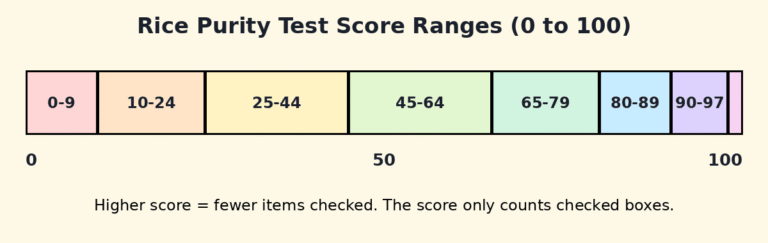
Think of it as a checklist rather than an exam. You start at 100 and subtract one point for every experience you mark as true for you. The number at the end is simply a count, not a grade.
From 10 Questions in 1924 to 100 Today
The history helps set expectations, because the test did not begin as a 100-question list.
The Rice Purity Test traces its name and early inspiration to The Rice Thresher, the student newspaper of Rice University in Houston. In 1924, the Thresher published the results of an informal ten-question survey given to 119 female undergraduate students. It was a campus curiosity, not a standardized national quiz.
The test was not always 100 questions. Later generations of Thresher staff revisited and expanded the list over the decades, and a much longer version appeared in 1988. The familiar modern 100-question format settled into place through further revisions and became the version that spread widely online.
That evolution explains why the modern version feels quick and conversational. It was shaped over time to be taken in one sitting, and it has always been a voluntary, informal campus tradition rather than a serious evaluation. Some details of the early history are debated, so it is best to describe the 1924 survey as the starting point rather than claim every modern feature dates to that year.
How to Take the Test at Your Own Pace
A few simple habits make the experience smoother.
- Find a private moment. Even if you plan to share your score later, answering privately makes it easier to be honest without worrying about someone reading over your shoulder.
- Answer for yourself, not for an audience. Trying to perform a high or low score for friends can make the result feel less meaningful to you.
- Do not overthink each item. The questionnaire is meant to be casual, so going with your first honest reaction usually keeps the process moving at a steady pace.
- Skip what you need to skip. If a question does not apply or feels uncomfortable, you can move on. Many versions allow skipping.
- Do not treat speed as a goal. Someone finishing in three minutes and someone finishing in ten minutes are both using the test in a valid way. Taking longer does not change your score, because the score depends only on the items you check, not on the minutes that pass.
One practical note: some online versions let you pause and return later, while others reset your progress if you refresh or close the page. The safest plan is to finish in one sitting while the questions are fresh in your mind.
Frequently Asked Questions
How long does the Rice Purity Test take?
Most people finish in one short sitting. Completion times are often reported informally as a few minutes for a fast pass, and closer to ten minutes if you read carefully and reflect on each question. There is no timer, so you can take as long as you need.
Is there a time limit on the Rice Purity Test?
No. The test is not timed, and there is no penalty for taking longer or pausing.
Why do some people finish faster than others?
Reading speed, how much someone pauses to think, whether the test is taken alone or with friends, and device or connection speed all affect the pace.
Does the Rice Purity Test always have 100 questions?
The modern version most people see has 100 yes-or-no items, but the original 1924 Rice Thresher survey had only ten questions. The 100-question format is a later descendant.
Does taking longer change my score?
No. Time spent has no effect on the final number. The score is simply 100 minus the number of items you mark as true for yourself.
Can I take it on my phone?
Yes. Many people do. A stable connection and a quiet moment make the experience smoother.
Does my score reflect my character or morals?
No. A score is a number produced by counting answers on a checklist. It is not a moral grade, a character judgment, or a measure of someone’s worth.
Final Thoughts
The Rice Purity Test is quick for most people because it is built as a simple checklist, not a long exam. A few minutes is a common informal range, and about ten minutes covers a careful, relaxed sitting. There is no official clock and no reason to rush.
The more useful question is not how fast you can finish, but whether you answered in a way that feels honest to you. The test is a snapshot of experiences, not a verdict on a person. Take it at your own pace, and treat the number as a conversation starter rather than a label.