Rice Purity Test FAQ: Scores, Results and Common Questions
The Rice Purity Test is a 100-item checklist about life experiences. You tick the items that apply to you, and the number left unchecked becomes your score, from 0 to 100. It is a lighthearted quiz, not a scientific measure, and these are the questions people ask most often about it: how it works, what scores mean, whether results are private, and how accurate the test really is.
If you have not taken it yet, you can take the Rice Purity Test quiz first and then come back to read this FAQ with your result in hand.
What Is the Rice Purity Test?
The Rice Purity Test is a yes-or-no checklist of 100 experiences and activities. It became popular with college students and friends who take it together and compare scores, and it is widely taken online today. It is a self-reflection and entertainment quiz, not a psychological assessment, and it has no official owner or standard version. Our Rice Purity Test history guide explains how it grew from a student newspaper feature into the online checklist people know today.
How Does the Rice Purity Test Work?
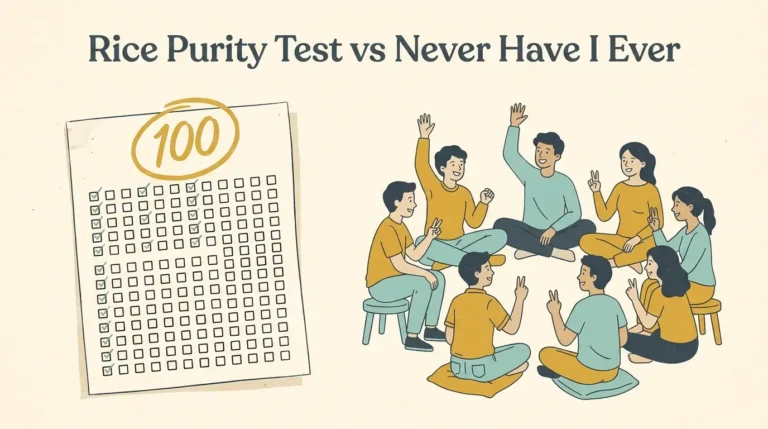
The format is simple. You see 100 items, each with a checkbox. You tick every item that applies to you, then the page calculates your result. The scoring starts at 100 and drops by one for every item you checked.
Score = 100 minus the number of items you checked
- Check 20 items and your score is 80.
- Check 55 items and your score is 45.
- Check nothing at all and your score is 100.
One caution: the exact wording and ordering of items differ from site to site, because online versions are unofficial copies. For a fuller walkthrough, see how the Rice Purity Test works.
What Do Rice Purity Test Scores Mean?
A higher score means fewer items on that particular checklist were checked. A lower score means more were checked. That is all the number literally says.
The number does not establish anyone’s character, worth, maturity, or morals. The list mixes very different experiences with equal weight, and it records only how many boxes were ticked, not which ones or in what circumstances. A Rice Purity Test score meaning guide on this site breaks down the score ranges and why the same number can mean different things for different people.
What Is a Good Rice Purity Test Score?
There is no universally good or bad score. The quiz is not a competition and there is no standard everyone is expected to meet. People compare scores with friends and classmates out of curiosity, which is fine as a conversation starter, but nobody needs to reach a particular number to fit in or feel good about themselves.
If you are comparing, keep in mind that score spreads within a friend group usually just reflect different backgrounds, ages, and circumstances. We have a separate guide on what counts as a good Rice Purity score if you want a longer discussion of the comparisons.
What Is the History of the Rice Purity Test?
The roots of the test trace back to the Rice Thresher, the student newspaper at Rice University in Houston, Texas. On March 7, 1924, the Thresher reported on a ten-question purity survey with results from 119 female undergraduates. That early survey was not the modern 100-question checklist; it was a small campus survey run as a newspaper feature.
The familiar online format developed through later versions and revisions. The Thresher itself published a 150-question version in its April Fools’ issue on April 1, 1988, and reported on the online test and its revisions in 2012. So the accurate way to say it is: the test’s roots trace to a 1924 Rice Thresher survey, while the online checklist people take today came together much later. Do not describe every online copy as an official Rice University test, because the university’s historical association does not make every copy an institutionally approved version.
Is the Rice Purity Test Official or Scientifically Accurate?
Online versions are unofficial copies or adaptations. The quiz has no established scientific validation as a psychological measurement tool. A numerical result is not a diagnosis, a clinical assessment, or a validated measure of innocence. You can read our detailed look at whether the Rice Purity Test is accurate, but the short version is that it is entertainment with a score, not a scientific instrument.
Can You Retake the Rice Purity Test?
Yes. Online versions can be retaken whenever you like. Your score may change if your experiences or answers change, and some people see small shifts from one sitting to the next because they read a borderline item differently. Answer honestly rather than choosing responses to reach a desired number; retaking the quiz does not make the result any more scientifically meaningful. Our guide on retaking the Rice Purity Test covers the details.
Are Rice Purity Test Results Private?
Privacy depends on the website hosting the quiz. Taking a quiz on this site is different from posting your score publicly or sending it to friends. Do not assume any answers are private, anonymous, or never stored unless the site’s privacy practices say so, so check the privacy policy of whichever site you use before entering information. For more, see our privacy and anonymity explainer.
Why Do People Share Their Rice Purity Scores?
Curiosity is the main reason. The test spread through campus traditions and online trends, and sharing scores gives friends a starting point for conversation about how different their experiences have been. Comparison has limits, though: people enter with different backgrounds and circumstances, so a wide spread of scores in a group is normal and not something to read into.
One point worth stating directly: nobody owes anyone else their answers or their score. Teasing or pressuring someone over a number goes against the spirit of a lighthearted quiz, and nobody should feel judged by a score.
More Rice Purity Test Questions Answered
The six most common questions, in short:
What is the Rice Purity Test?
The Rice Purity Test is a 100-item checklist about different life experiences. You check the items that apply to you and receive a score from 0 to 100. It is mainly used for entertainment and self-reflection.
What does my Rice Purity Test score mean?
Your score shows how many items on the checklist you left unchecked. A higher score means you checked fewer experiences, while a lower score means you checked more. It does not define who you are as a person.
What is a good Rice Purity Test score?
There is no universally good or bad score. Everyone has different experiences, backgrounds, and personal boundaries. You do not need to reach a particular number to fit in or feel good about yourself.
What is the average Rice Purity Test score?
There is no single, reliable average that represents everyone who takes the test. Scores reported online are often informal estimates that come from different groups, and they vary from source to source. Treat comparisons as entertainment rather than representative statistics. Our average Rice Purity score guide explains why no single figure can be trusted.
Can I retake the Rice Purity Test?
Yes. You can retake an online version whenever you want. Your score may change if your experiences or answers change. Answer honestly rather than trying to achieve a particular result.
Is the Rice Purity Test scientifically accurate?
The Rice Purity Test is not a scientifically validated psychological assessment. It gives you a score based on your answers, but it cannot measure your character, personal worth, or overall life experience.