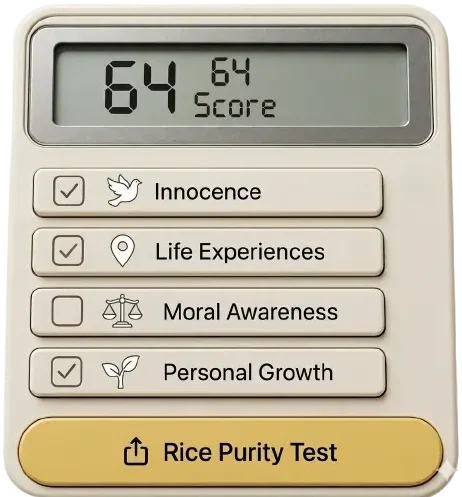
Phone Addiction Purity Test: 100 Questions to Check Your Score
The Rice Purity Test format has spread far beyond its original topic, and the phone addiction purity test is one of the most useful spin-offs: the same checklist style, applied to how you actually use your phone.
Instead of relationships and life experiences, the phone addiction purity test checks off habits like doomscrolling, phantom vibrations, and checking your phone the second you wake up. This guide covers what the phone addiction purity test actually measures, how scoring works, and how it compares to real clinical screening tools.
What Is the Phone Addiction Purity Test?
The phone addiction purity test is a self-assessment checklist built the same way as the original Rice Purity Test. You go through a list of common phone and social media habits, checking off anything that applies to you, and your total produces a score.
Unlike the original test, the goal of the phone addiction purity test isn’t nostalgia or bragging rights. It’s a quick, honest snapshot of your relationship with your phone, treated as a light self-check rather than a diagnosis. As with any smartphone addiction test of this casual, checklist style, it’s meant to prompt reflection, not deliver a verdict.
How the Phone Addiction Purity Test Scoring Works
The mechanic is identical to the classic Rice Purity Test format:
- You start with a perfect score of 100.
- Every habit you check off subtracts a point.
- Your final phone addiction purity test score is 100 minus the number of habits that applied to you.
A higher score means fewer of the listed habits apply to you, suggesting a lighter relationship with your phone. A lower score means more of them do, suggesting your phone plays a bigger role in your day-to-day life than you might realize.
What Kinds of Questions the Phone Addiction Purity Test Includes
A typical phone addiction purity test covers habits grouped into a few broad categories:
- Morning and night habits: checking your phone within minutes of waking up, or as the last thing before sleep
- Phantom sensations: feeling your phone vibrate when it didn’t, or reaching for it out of habit rather than need
- Social media patterns: scrolling without a specific reason, losing track of time on an app, checking a post repeatedly for reactions
- Real-life impact: checking your phone during a conversation, a meal, or while driving
- Emotional response: feeling anxious or irritable when your phone isn’t nearby or the battery is low
Just like the original Rice Purity Test, these questions run from mild and extremely common to more habitual and harder to shake, which is why most people don’t land at either extreme end of the scale.
Phone Addiction Purity Test Score Meaning
| Score Range | General Description |
|---|---|
| 80-100 | A light relationship with your phone. Most of the listed habits don’t apply to you. |
| 60-79 | Some habitual use, but nothing unusual for most smartphone users. |
| 40-59 | A fair number of habits apply. Your phone plays a noticeable role in your daily routine. |
| 20-39 | Many of the listed habits apply. Your phone use shapes a good part of your day. |
| 0-19 | Nearly all the listed habits apply. Phone use has a heavy presence in your daily life. |
As with the original Rice Purity Test, there’s no scientific validation behind these bands. A phone addiction purity test score is a rough, informal guide, not a clinical measurement, no matter how detailed the question list gets.
Is the Phone Addiction Purity Test a Real Diagnostic Tool?
No, and it’s worth being clear about that upfront. This quiz format, like every phone addiction purity test built on the Rice Purity checklist style, is meant for quick self-reflection, not medical or psychological diagnosis. “Smartphone addiction” itself isn’t a formally recognized clinical diagnosis in the first place, which is part of why casual checklists exist for it rather than a single official test.
That said, real validated screening tools do exist, and they work differently than a casual checklist. The most widely used is the Smartphone Addiction Scale, Short Version (SAS-SV), a 10-item scale developed by researchers and used in studies worldwide. It was built to flag loss of control over phone use, not simply hours logged, and its original validation study set an at-risk cutoff of 31 out of 60 for men and 33 out of 60 for women.
If checking off most of the phone addiction purity test’s list genuinely concerns you, that’s worth taking seriously, just not from a checklist result alone. A validated tool like the SAS-SV, or a conversation with a doctor or counselor, is a better next step than any informal online quiz, including this one.
How the Phone Addiction Purity Test Compares to the Original Rice Purity Test
| Rice Purity Test | Phone Addiction Purity Test | |
|---|---|---|
| Topic | Life experiences: relationships, parties, substances, and more | Phone and social media habits specifically |
| Format | 100 yes/no questions, one point each | Same checklist format, usually a shorter list |
| Purpose | Nostalgic self-reflection and comparing with friends | A quick, informal check on your digital habits |
| Scientific basis | None; created informally by students in 1924 | None for the checklist itself; real validated alternatives like the SAS-SV do exist separately |
| Should it replace professional advice | No, entertainment only | No, entertainment only, and not a substitute for a real screening tool if you’re concerned |
Common Misconceptions
| Misconception | Reality |
|---|---|
| The phone addiction purity test is a clinical diagnostic tool | It’s an informal, entertainment-style checklist. Real diagnosis requires a licensed professional |
| “Smartphone addiction” is an official medical diagnosis | It isn’t formally recognized as a standalone diagnosis, which is part of why informal checklists like this one exist |
| A low score proves you’re addicted | It only shows how many listed habits apply to you. It isn’t a validated clinical measurement |
| All phone habit quizzes are equally accurate | Casual checklists and validated tools like the SAS-SV are built very differently, with the SAS-SV backed by published research |
Frequently Asked Questions
Is the phone addiction purity test scientifically accurate?
No. It’s a casual, checklist-style self-assessment inspired by the Rice Purity Test format, not a validated psychological instrument. Treat your score as a light prompt for reflection, not a diagnosis.
What’s a normal score on this test?
There’s no official average for this style of checklist. Most people land somewhere in the middle, since checking your phone frequently is extremely common in daily life and doesn’t by itself indicate a problem.
Should I be worried if I score very low?
A low score just means many of the listed habits apply to you. If it genuinely concerns you, a validated tool like the SAS-SV, or a conversation with a doctor or counselor, is a more useful next step than an online quiz result.
Is this test related to the original Rice Purity Test?
Only in format. It borrows the same check-off, point-per-item scoring style, but the questions are entirely about phone and social media habits instead of general life experiences.
Is there an official phone addiction test?
Not in the same sense as this checklist. The closest thing is a validated research instrument like the Smartphone Addiction Scale, Short Version, which is scored and interpreted very differently than a casual purity-test-style quiz.
Curious About the Original Test?
If you haven’t taken the Rice Purity Test yet, head over to try the original 100-question version, or check out our guide to Rice Purity Score Meaning to see what your number says.
Genuine screening tools for problematic phone or internet use, such as the Smartphone Compulsion Test developed by addiction researcher Dr. David Greenfield, offer another validated way to check in on your habits beyond a casual checklist.