Rice Purity Test Score Meaning: What Every Score Range Says
Rice Purity Score Meaning Checker
Enter your score (0 to 100) to see what it mathematically means, how many items you checked, and where it lands on the 0 to 100 scale.
Take the Rice Purity TestCheck Your Score
0 to 2 of the 100 items applied. Usually reflects age, circumstances or personal choices. It says nothing about character.
Compare Scores
Compare your score with a friend to inspect the mathematical point difference and checked counts.
All 8 Score Ranges
Frequently Asked Questions
What does a Rice Purity Test score mean? ▾
How is the score calculated? ▾
What does a score of 80 mean? ▾
What does a score of 50 mean? ▾
Is a higher score better? ▾
Is there an average Rice Purity Test score? ▾
Read the full Rice Purity Test Score Meaning guide to see what every score range says.
Your Rice Purity Test score is a single number between 0 and 100, and it only counts how many of the checklist items you checked. It does not measure character, maturity, or how “good” a person is. This guide explains how the score is calculated, what each range generally indicates, and why the same number can mean very different things for different people.
If you have not taken the test yet, you can try the Rice Purity Test quiz first and come back with your result.
Already have your score? Use the Rice Purity Score Meaning Checker to enter any number from 0 to 100 and see exactly which range it falls in.
How the Rice Purity Score Is Calculated
The math is simple. The test has 100 yes-or-no items. You start at 100 points, and every item you check subtracts one point.
Score = 100 minus the number of items you checked
- Check 0 items and your score is 100.
- Check 20 items and your score is 80.
- Check 50 items and your score is 50.
- Check all 100 and your score is 0.
Every item carries the same weight. Checking a mild item such as holding hands costs exactly as much as checking a more serious one. This is why two people with the same score can have very different answer sets, which comes up again below.
Where the Test Comes From
The test traces back to the Rice University student newspaper, the Rice Thresher. According to Wikipedia’s entry on purity tests, the Thresher published the results of an informal ten-question survey of 119 female undergraduates in 1924. The paper has revised the list many times since, usually as a humor feature, and purity tests began circulating online around 1980.
The Thresher’s own reporting says the version most people know today, with 100 questions worth one point each, was published online in 2012. The test spread from Rice orientation traditions to colleges and high schools, and later to social media.
Rice Purity Score Chart: Ranges Explained
Official score bands do not exist. The test has no scientific scoring key, so every site that publishes a chart makes its own cutoffs. The bands below are simple arithmetic groupings meant to make a number easier to read. They are not personality types and not percentiles.
| Score range | Items checked | What the range generally indicates |
|---|---|---|
| 98-100 | 0 to 2 | Almost nothing on the list has been checked |
| 90-97 | 3 to 10 | A handful of early, common experiences |
| 80-89 | 11 to 20 | Some experiences, with most of the list unchecked |
| 65-79 | 21 to 35 | A moderate number of items checked, often from the early and middle parts of the list |
| 45-64 | 36 to 55 | Roughly a third to a half of the list checked |
| 25-44 | 56 to 75 | A majority of the list checked, covering several categories |
| 10-24 | 76 to 90 | Most of the list checked |
| 0-9 | 91 to 100 | Nearly every item checked |
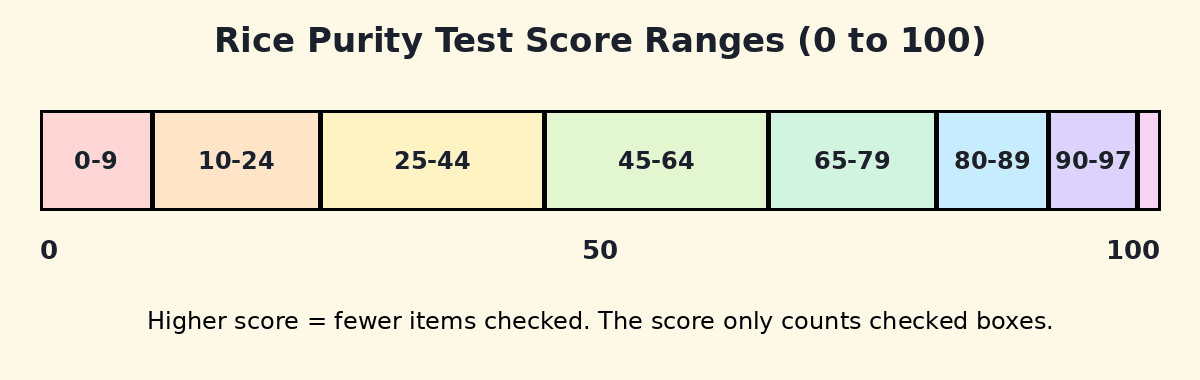
A few things worth keeping in mind when reading the chart:
- Bands near the top are narrow because early items are common and tend to be checked first.
- The middle bands are wide, so the exact number tells you more than the band label does.
- The chart describes a count, not a category of person.
What a Higher Score Says vs. a Lower Score
A higher score means fewer boxes were checked. A lower score means more boxes were checked. That is the entire factual content of the number.
The list is ordered roughly from common social and romantic experiences to rarer or riskier ones, so a high score usually means the person has stopped checking early in the list. A lower score means they have checked items from more of the list. Even so, the number cannot tell you which items were checked, in what circumstances, or by choice.
Neither direction is better. A higher score is not a sign of being boring or sheltered, and a lower score is not a sign of being reckless. Many people simply have different schedules, upbringings, health considerations, personal values, or opportunities.
Why the Same Score Can Mean Different Things
Because every item counts equally and the test never records which items you checked, one score can come from many different answer sets. Consider two people who both score 75. One may have checked 25 items about dating, parties, and school-related rule bending. The other may have checked 25 items concentrated in a completely different area. The number is identical, and the stories are not.
Context shifts the meaning too:
- Age and life stage. Someone starting college and someone a few years past graduation have had different amounts of time to accumulate experiences.
- Environment. Where a person grew up, what their school or community was like, and what was available to them all affect the result.
- Personal choices. Some people check few items because of beliefs or preferences, not lack of opportunity.
- Interpretation. Several items are ambiguous, and two honest people can read the same item differently.
What Does a Rice Purity Score of 80 Mean?
An 80 means 20 items were checked and 80 were left unchecked. In the table above, it sits in the 80 to 89 band, which is toward the higher end of the scale. In practical terms, the person has checked some items but not most of the list.
Beyond that arithmetic, an 80 does not carry a built-in meaning. It does not indicate a personality type, a level of maturity, or a particular set of experiences. Whether 80 feels high or low depends on the group you are comparing yourself to, and as the next sections explain, that comparison is shakier than it looks.
What Does a Rice Purity Score of 70 Mean?
A 70 means 30 items were checked. It falls in the 65 to 79 band, in the upper-middle of the scale. Thirty checked items can be spread across the dating, social, and rule-bending sections without reaching the later, rarer items. As with any score, the number cannot confirm that pattern. It only confirms that 70 items were left unchecked.
What Does a Rice Purity Score of 50 Mean?
A 50 is the exact midpoint: 50 items checked and 50 unchecked. It is a convenient reference number, but it is not a verified “average.” A midpoint on a checklist is a matter of arithmetic, not a statement about what most people score.
Is My Rice Purity Score Good?
No score on this test is objectively good or bad, because the test is not designed to rank people. It is an informal self-reported checklist that began as a campus icebreaker. A “good” score is whatever you feel comfortable with, and the number says nothing about your worth.
If you are comparing your result with friends, a more useful framing is that the number is a conversation starter. The Rice Thresher’s reporting includes a student who pointed out that everyone enters college with different experiences, and that seeing a wide spread of scores in a group made the number matter less. If you want to see where you land, you can check your score here and read it alongside the ranges above.
Is There an Average Rice Purity Score?
There is no verified universal average. The test is anonymous, self-reported, and has no central owner collecting a representative sample, so any single “average” you see online describes only the people who took that particular version on that particular site.
The published figures illustrate the problem:
- The Rice Thresher reported that the average for the 119 women who took the 1924 test was 62, but that was a ten-question test with different scoring.
- The Thresher also reported an average of 65 among Houston test takers on one day in 2017, which is a narrow, self-selected group.
- Various test sites advertise averages anywhere from the low 50s to the high 60s for all users, and some report figures above 90 for under-18 users. These are informal online estimates, not audited data, and they conflict with each other.
Treat any statement like “the average score is X” as unverified unless it names its sample, collection method, and date.
Why Different Websites Give Different Scores
If you took the test twice on two sites and got two numbers, nothing is necessarily wrong. The test has no official owner, and the version you see depends on the site. Common reasons for the gap:
- Different question lists. Sites reword, add, cut, or reorder items, so you may not be answering the same 100 questions.
- Different question counts. Although 100 is the modern standard, shorter and longer versions circulate under the same name. Wikipedia notes that the number of questions varies.
- Different scoring scales. A site that uses a different total or shows a percentage will give a number that looks different even when the answers are the same.
- Interface quirks. Pre-checked boxes, skipped items, or multi-page layouts can quietly change a total.
- Your own answers. Recall and borderline interpretations shift between sittings, so a retake can move a few points.
If you want to compare with friends, have everyone use the same site on the same day, and confirm that every box starts empty.
Why the Score Is Not a Scientific Measure
The Rice Purity Test is a self-graded survey. No researcher validated the questions, no one verifies the answers, and the scoring treats very different experiences as identical single points. Three limits are worth stating plainly:
- It is self-reported, so honesty, memory, and mood all affect the result.
- It is unvalidated, meaning no study has shown that it measures a defined trait.
- It is uncalibrated, so there are no norms or percentiles to compare against.
For those reasons, the score should not be used to evaluate maturity, health, relationships, or compatibility. It is entertainment and a social conversation piece, nothing more.
The Bottom Line
Your Rice Purity Test score meaning comes down to one formula: 100 minus the number of items you checked. A higher score means fewer checked items, a lower score means more, and neither direction is better or worse. There is no verified average to compare against and no scientific scale behind the number, so the score works best as a conversation starter. If you have not taken it yet, you can take the quiz here and read your result against the chart above.
Frequently Asked Questions
How do I convert my score into the number of items I checked?
Subtract your score from 100. A score of 82 means 18 items were checked, and a score of 41 means 59 were checked.
Is a high or low Rice Purity score better?
Neither. A higher score means fewer checked items, and a lower score means more. The test is not a moral grade.
Can two people with the same score have different answers?
Yes, and this is the normal case. The score counts checked items without recording which ones, so any selection of the same size gives the same total. Only 100 and 0 point to a single possible answer set.
What is the lowest possible score?
Zero, which means all 100 items were checked.
Can I retake the test?
Yes. Scores can shift on a retake because of recall, new experiences, or different readings of borderline items. You can retake the quiz anytime to see how your result changes.
Is the Rice Purity Test official or scientific?
No. It started as a student newspaper feature at Rice University, and today’s online versions are independent copies with no scientific validation.